Palo Alto Networks XDR-Analyst資格認証攻略 & XDR-Analyst関連資料
Wiki Article
無料でクラウドストレージから最新のPass4Test XDR-Analyst PDFダンプをダウンロードする:https://drive.google.com/open?id=1Y2WrsFsD9KZxODP7cMTPFV8EZ1Jevkq7
Pass4Testは専門的な、受験生の皆さんを対象とした最も先進的なPalo Alto NetworksのXDR-Analyst試験の認証資料を提供しているサイトです。Pass4Testを利用したら、Palo Alto NetworksのXDR-Analyst試験に合格するのを心配することはないです。
XDR-Analyst最新の試験トレントは、資格試験ごとに分類が異なるため、ユーザーはユーザーの実際のニーズに応じて独自の学習モードを選択できます。 XDR-Analyst試験の質問は、ユーザーが選択できるさまざまな学習モードを提供します。これは、コンピューターや携帯電話の複数のクライアントがオンラインで勉強したり、オフライン統合のためにデータを印刷したりするために使用できます。手頃な価格と実践を完璧にサポートする最新のXDR-Analyst試験のトレントは、XDR-Analyst試験の質問のみを気に入っています。
>> Palo Alto Networks XDR-Analyst資格認証攻略 <<
Palo Alto Networks XDR-Analyst関連資料 & XDR-Analystテスト問題集
努力する人生と努力しない人生は全然違いますなので、あなたはのんびりした生活だけを楽しみしていき、更なる進歩を求めるのではないか?スマートを一方に置いて、我々Palo Alto NetworksのXDR-Analyst試験問題集をピックアップします。弊社のXDR-Analyst試験問題集によって、あなたの心と精神の満足度を向上させながら、勉強した後XDR-Analyst試験資格認定書を受け取って努力する人生はすばらしいことであると認識られます。
Palo Alto Networks XDR-Analyst 認定試験の出題範囲:
| トピック | 出題範囲 |
|---|---|
| トピック 1 |
|
| トピック 2 |
|
| トピック 3 |
|
| トピック 4 |
|
Palo Alto Networks XDR Analyst 認定 XDR-Analyst 試験問題 (Q17-Q22):
質問 # 17
Which Type of IOC can you define in Cortex XDR?
- A. destination port
- B. App-ID
- C. e-mail address
- D. full path
正解:D
解説:
Cortex XDR allows you to define IOCs based on various criteria, such as file hashes, registry keys, IP addresses, domain names, and full paths. A full path IOC is a specific location of a file or folder on an endpoint, such as C:WindowsSystem32calc.exe. You can use full path IOCs to detect and respond to malicious files or folders that are located in known locations on your endpoints12.
Let's briefly discuss the other options to provide a comprehensive explanation:
A . destination port: This is not the correct answer. Destination port is not a type of IOC that you can define in Cortex XDR. Destination port is a network attribute that indicates the port number to which a packet is sent. Cortex XDR does not support defining IOCs based on destination ports, but you can use XQL queries to filter network events by destination ports3.
B . e-mail address: This is not the correct answer. E-mail address is not a type of IOC that you can define in Cortex XDR. E-mail address is an identifier that is used to send and receive e-mails. Cortex XDR does not support defining IOCs based on e-mail addresses, but you can use the Cortex XDR - IOC integration with Cortex XSOAR to ingest IOCs from various sources, including e-mail addresses4.
D . App-ID: This is not the correct answer. App-ID is not a type of IOC that you can define in Cortex XDR. App-ID is a feature of Palo Alto Networks firewalls that identifies and controls applications on the network. Cortex XDR does not support defining IOCs based on App-IDs, but you can use the Cortex XDR Analytics app to create custom rules that use App-IDs as part of the rule logic5.
In conclusion, full path is the type of IOC that you can define in Cortex XDR. By using full path IOCs, you can enhance your detection and response capabilities and protect your endpoints from malicious files or folders.
Reference:
Create an IOC Rule
XQL Reference Guide: Network Events Schema
Cortex XDR - IOC
Cortex XDR Analytics App
PCDRA: Which Type of IOC can define in Cortex XDR?
質問 # 18
To create a BIOC rule with XQL query you must at a minimum filter on which field in order for it to be a valid BIOC rule?
- A. endpoint_name
- B. causality_chain
- C. event_type
- D. threat_event
正解:C
解説:
To create a BIOC rule with XQL query, you must at a minimum filter on the event_type field in order for it to be a valid BIOC rule. The event_type field indicates the type of event that triggered the alert, such as PROCESS, FILE, REGISTRY, NETWORK, or USER_ACCOUNT. Filtering on this field helps you narrow down the scope of your query and focus on the relevant events for your use case. Other fields, such as causality_chain, endpoint_name, threat_event, are optional and can be used to further refine your query or display additional information in the alert. Reference:
Palo Alto Networks Certified Detection and Remediation Analyst (PCDRA) Study Guide, page 9 Palo Alto Networks Cortex XDR Documentation, BIOC Rule Query Syntax
質問 # 19
Which statement is correct based on the report output below?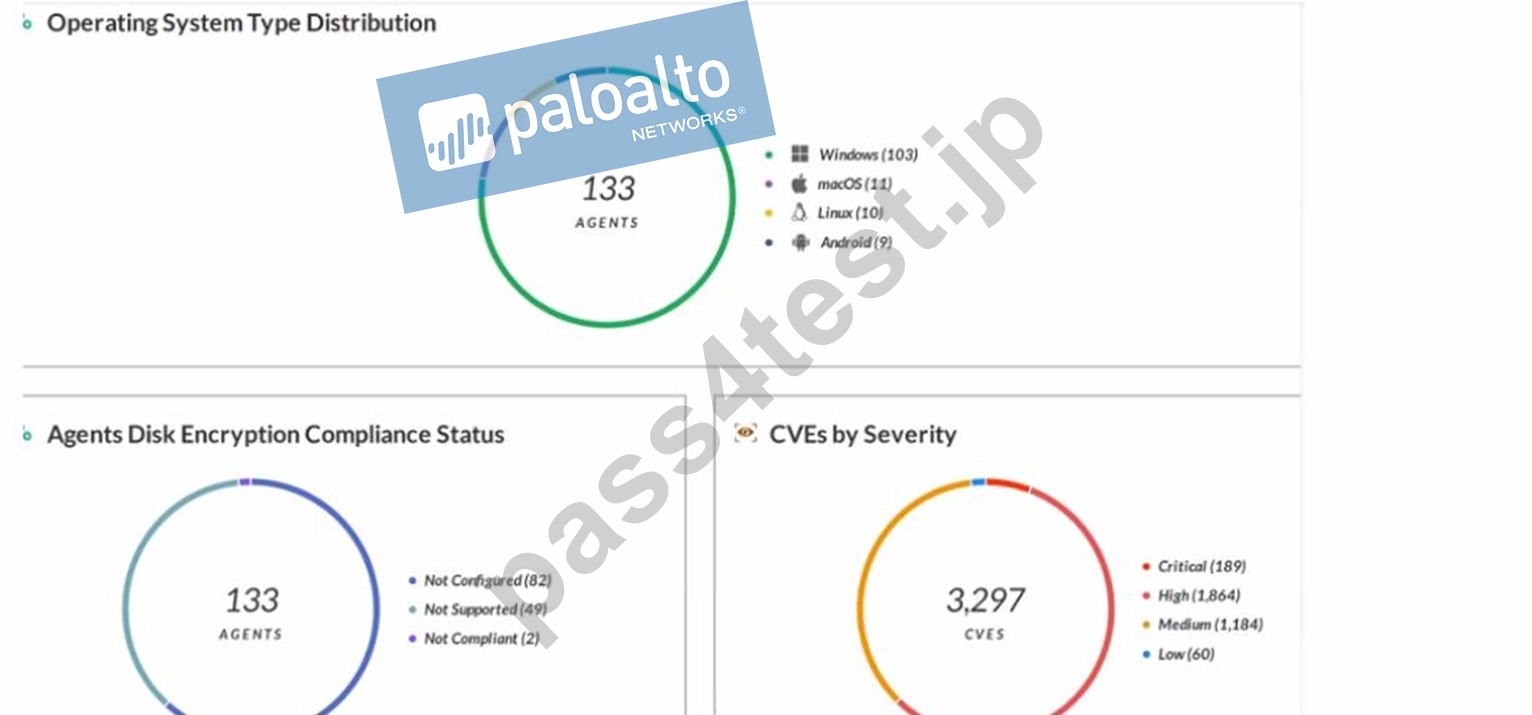
- A. Forensic inventory data collection is enabled.
- B. 3,297 total incidents have been detected.
- C. Host Inventory Data Collection is enabled.
- D. 133 agents have full disk encryption.
正解:A
解説:
The report output shows the number of endpoints that have forensic inventory data collection enabled, which is a feature of Cortex XDR that allows the collection of detailed information about the endpoint's hardware, software, and network configuration. This feature helps analysts to investigate and respond to incidents more effectively by providing a comprehensive view of the endpoint's state and activity. Forensic inventory data collection can be enabled or disabled per policy in Cortex XDR. Reference:
Forensic Inventory Data Collection
Cortex XDR 3: Getting Started with Endpoint Protection
質問 # 20
Cortex XDR Analytics can alert when detecting activity matching the following MITRE ATT&CKTM techniques.
- A. Exfiltration, Command and Control, Lateral Movement
- B. Exfiltration, Command and Control, Collection
- C. Exfiltration, Command and Control, Impact
- D. Exfiltration, Command and Control, Privilege Escalation
正解:A
解説:
Cortex XDR Analytics is a feature of Cortex XDR that leverages machine learning and behavioral analytics to detect and alert on malicious activity across the network and endpoint layers. Cortex XDR Analytics can alert when detecting activity matching the following MITRE ATT&CKTM techniques: Exfiltration, Command and Control, Lateral Movement, Execution, Persistence, Privilege Escalation, Defense Evasion, Credential Access, Discovery, and Collection. However, among the options given in the question, the correct answer is D, Exfiltration, Command and Control, Lateral Movement. These are three of the most critical techniques that indicate an advanced and persistent threat (APT) in the environment. Exfiltration refers to the technique of transferring data or information from the compromised system or network to an external location controlled by the adversary. Command and Control refers to the technique of communicating with the compromised system or network to provide instructions, receive data, or update malware. Lateral Movement refers to the technique of moving from one system or network to another within the same environment, usually to gain access to more resources or data. Cortex XDR Analytics can alert on these techniques by analyzing various data sources, such as network traffic, firewall logs, endpoint events, and threat intelligence, and applying behavioral models, anomaly detection, and correlation rules. Cortex XDR Analytics can also map the alerts to the corresponding MITRE ATT&CKTM techniques and provide additional context and visibility into the attack chain1234 Reference:
Cortex XDR Analytics
MITRE ATT&CKTM
Cortex XDR Analytics MITRE ATT&CKTM Techniques
Cortex XDR Analytics Alert Categories
質問 # 21
Which of the following represents a common sequence of cyber-attack tactics?
- A. Reconnaissance - Installation - Weaponization & Delivery -Exploitation - Command & Control - Actions on the objective
- B. Installation - Reconnaissance - Weaponization & Delivery - Exploitation - Command & Control - Actions on the objective
- C. Reconnaissance - Weaponization & Delivery - Exploitation - Installation - Command & Control - Actions on the objective
- D. Actions on the objective - Reconnaissance - Weaponization & Delivery - Exploitation - Installation - Command & Control
正解:C
解説:
A common sequence of cyber-attack tactics is based on the Cyber Kill Chain model, which describes the stages of a cyber intrusion from the perspective of the attacker. The Cyber Kill Chain model consists of seven phases: reconnaissance, weaponization, delivery, exploitation, installation, command and control, and actions on the objective. These phases are briefly explained below:
Reconnaissance: The attacker gathers information about the target, such as its network, systems, vulnerabilities, employees, and business operations. The attacker may use various methods, such as scanning, phishing, or searching open sources, to collect data that can help them plan the attack.
Weaponization: The attacker creates or obtains a malicious payload, such as malware, exploit, or script, that can be used to compromise the target. The attacker may also embed the payload into a delivery mechanism, such as an email attachment, a web link, or a removable media.
Delivery: The attacker sends or delivers the weaponized payload to the target, either directly or indirectly. The attacker may use various channels, such as email, web, or physical access, to reach the target's network or system.
Exploitation: The attacker exploits a vulnerability or weakness in the target's network or system to execute the payload. The vulnerability may be technical, such as a software flaw, or human, such as a social engineering trick.
Installation: The attacker installs or drops additional malware or tools on the target's network or system to establish a foothold and maintain persistence. The attacker may use various techniques, such as registry modification, file manipulation, or process injection, to hide their presence and evade detection.
Command and Control: The attacker establishes a communication channel between the compromised target and a remote server or controller. The attacker may use various protocols, such as HTTP, DNS, or IRC, to send commands and receive data from the target.
Actions on the objective: The attacker performs the final actions that achieve their goal, such as stealing data, destroying files, encrypting systems, or disrupting services. The attacker may also try to move laterally within the target's network or system to access more resources or data.
Reference:
Cyber Kill Chain: This document explains the Cyber Kill Chain model and how it can be used to analyze and respond to cyberattacks.
Cyber Attack Tactics: This document provides an overview of some common cyber attack tactics and examples of how they are used by threat actors.
質問 # 22
......
実際の試験に応じて、実践のために最新のXDR-Analyst試験ダンプを提供します。最新のXDR-Analystテストの質問を使用すると、テストの実践で良い経験をすることができます。さらに、価格について心配する必要はありません。さらにパートナーシップを結ぶために、1年間半額の無料アップデートを提供します。これは、この分野で大きな売り上げです。お支払い後、更新されたXDR-Analyst試験をすぐに送信します。更新に関する質問がある場合は、XDR-Analyst試験の質問にメッセージを残してください。
XDR-Analyst関連資料: https://www.pass4test.jp/XDR-Analyst.html
- XDR-Analyst勉強時間 ???? XDR-Analyst復習資料 ???? XDR-Analyst試験時間 ???? ✔ www.it-passports.com ️✔️を開き、▛ XDR-Analyst ▟を入力して、無料でダウンロードしてくださいXDR-Analyst問題集無料
- XDR-Analyst試験勉強過去問 ???? XDR-Analystブロンズ教材 ???? XDR-Analyst全真模擬試験 ???? ⏩ www.goshiken.com ⏪を入力して➽ XDR-Analyst ????を検索し、無料でダウンロードしてくださいXDR-Analyst全真模擬試験
- 権威のあるXDR-Analyst資格認証攻略一回合格-実際的なXDR-Analyst関連資料 ???? ▷ www.mogiexam.com ◁の無料ダウンロード➥ XDR-Analyst ????ページが開きますXDR-Analyst学習指導
- XDR-Analyst過去問題 ???? XDR-Analyst受験トレーリング ???? XDR-Analyst問題集無料 ???? ⏩ www.goshiken.com ⏪には無料の➥ XDR-Analyst ????問題集がありますXDR-Analyst的中関連問題
- 試験の準備方法-便利なXDR-Analyst資格認証攻略試験-有効的なXDR-Analyst関連資料 ???? ウェブサイト▛ www.xhs1991.com ▟を開き、⏩ XDR-Analyst ⏪を検索して無料でダウンロードしてくださいXDR-Analyst勉強時間
- XDR-Analyst合格率書籍 ???? XDR-Analyst真実試験 ???? XDR-Analyst受験トレーリング ???? 《 www.goshiken.com 》で⇛ XDR-Analyst ⇚を検索して、無料で簡単にダウンロードできますXDR-Analyst再テスト
- XDR-Analystトレーリングサンプル ↗ XDR-Analyst受験対策書 ???? XDR-Analyst合格率書籍 ???? ウェブサイト⇛ www.passtest.jp ⇚を開き、【 XDR-Analyst 】を検索して無料でダウンロードしてくださいXDR-Analyst的中関連問題
- GoShikenはPalo Alto Networks XDR-Analyst試験の実践訓練を提供する ???? ▷ www.goshiken.com ◁で✔ XDR-Analyst ️✔️を検索して、無料で簡単にダウンロードできますXDR-Analyst基礎訓練
- XDR-Analyst試験の準備方法|素敵なXDR-Analyst資格認証攻略試験|100%合格率のPalo Alto Networks XDR Analyst関連資料 ???? “ www.xhs1991.com ”を入力して✔ XDR-Analyst ️✔️を検索し、無料でダウンロードしてくださいXDR-Analyst試験時間
- XDR-Analyst真実試験 ???? XDR-Analyst真実試験 ???? XDR-Analyst基礎訓練 ???? Open Webサイト⇛ www.goshiken.com ⇚検索[ XDR-Analyst ]無料ダウンロードXDR-Analystトレーリングサンプル
- 権威のあるXDR-Analyst資格認証攻略一回合格-実際的なXDR-Analyst関連資料 ???? ✔ XDR-Analyst ️✔️を無料でダウンロード☀ www.xhs1991.com ️☀️ウェブサイトを入力するだけXDR-Analyst受験トレーリング
- allenzmor825661.wikibestproducts.com, digibookmarks.com, kathrynnijj827374.wikinarration.com, tiannaeroa694606.bloggosite.com, socialislife.com, georgiajhyn747195.vblogetin.com, socialmediastore.net, adamarvt827420.blog-eye.com, www.stes.tyc.edu.tw, teachmetcd.com, Disposable vapes
P.S.Pass4TestがGoogle Driveで共有している無料の2026 Palo Alto Networks XDR-Analystダンプ:https://drive.google.com/open?id=1Y2WrsFsD9KZxODP7cMTPFV8EZ1Jevkq7
Report this wiki page